Currently Empty: $0.00
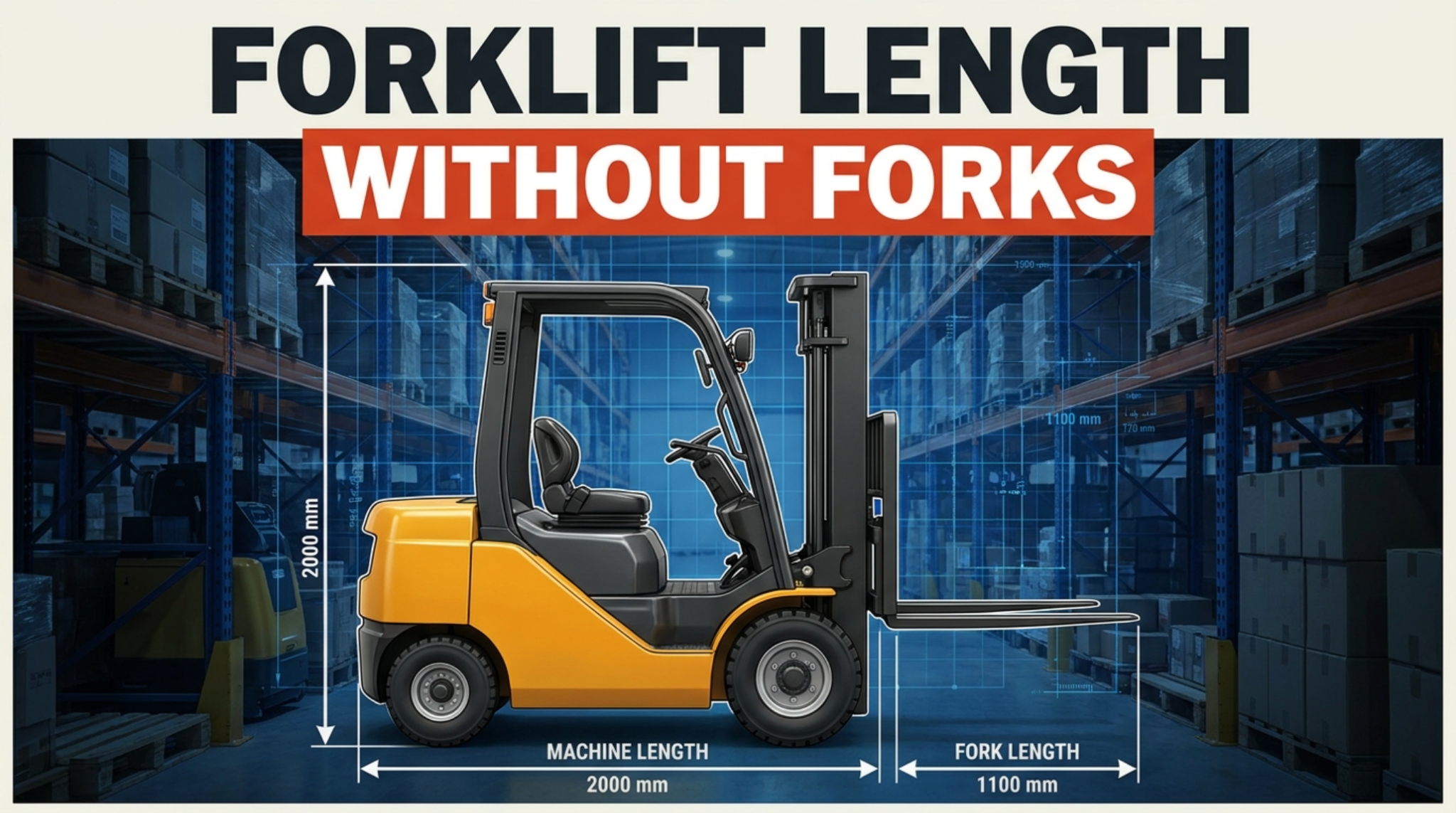
Forklift Length Without Forks: Why Machine Dimensions Matter
Forklift buyers often study lift height and load capacity closely, yet the machine’s length without forks quietly shapes how well the truck fits your workspace. This base measurement, taken from the back of the counterweight to the front face of the carriage, tells you how the forklift moves, turns, and travels before the forks add their own length. Get it right, and the machine works smoothly through aisles, doorways, and loading areas. Overlook it, and you may face tight turns, blocked passages, and clearance problems that slow every task. This guide explains why machine dimensions matter, how forks add to the working length, and what to compare before you choose a forklift.
Overall Machine Length Affects Maneuverability
The forklift’s length without forks is one of the strongest indicators of how easily the machine moves through your workspace. This measurement covers the main body of the truck, from the rear counterweight to the front of the carriage, and it sets the baseline for how the forklift behaves in tight quarters. A shorter machine occupies less floor space and generally handles better in narrow aisles, confined corners, and busy work areas where every inch counts. When you are weaving between racking, pallets, and other equipment, a compact base length makes the difference between smooth movement and constant repositioning.
Maneuverability is not only about squeezing through gaps. It also affects how confidently operators can work at speed and how much room they need to line up a load. A forklift with a shorter body responds more nimbly, allowing operators to adjust position quickly without swinging a long tail into shelving or walls. In warehouses with high-density storage, this agility translates directly into faster picking and putaway, since operators spend less time inching the machine into place.
Consider how base length shapes daily work in a few common settings:
- Narrow aisles: a shorter machine turns and repositions with less clearance, reducing the risk of striking racking.
- Confined docks: compact dimensions help operators maneuver near trucks and walls without excessive shuffling.
- Crowded floors: a smaller footprint eases movement around other equipment and foot traffic.
When the base length suits your environment, the forklift feels responsive and predictable. When it is too long for the space, operators fight the machine on every turn, which slows the work and raises the chance of contact with obstacles. Matching machine length to your layout is a practical first step toward safe, efficient operation.
Forks Add to the Working Length
The length without forks describes the machine’s base, but the forks themselves extend well beyond the carriage and add to the total length during operation. This distinction matters more than many buyers realize. A specification sheet may list a compact base length, yet once the forks are attached, the working footprint of the machine grows considerably. Understanding both figures separately helps you plan accurately, because the space the forklift needs while carrying a load is always greater than the base body alone suggests.
Standard forks commonly measure around 42 to 48 inches, though longer forks are used for deep pallets or specialized loads. That added length changes how the machine moves and how much room it needs in front. When an operator drives with forks extended, the front of the machine reaches farther than the base measurement indicates, which affects clearance at intersections, near racking, and around parked equipment. Separating the base dimension from the fork length lets you calculate the true operating length for your specific setup.
This separation is useful for a few reasons. First, it allows you to compare machines on equal terms, since fork lengths can vary between configurations. Second, it helps you plan storage and travel paths using the base length while accounting for the forks during active work. Third, it clarifies how the machine will behave when the forks are raised, lowered, or removed for transport. By knowing the base dimensions and the fork length as two distinct numbers, you gain a clearer picture of how the forklift fits your workspace both at rest and in motion. That clarity prevents surprises when the machine arrives and has to perform in the real layout of your facility.
Turning Space Depends on Machine Dimensions
The space a forklift needs to turn and reposition depends heavily on its dimensions, and length plays a central role. A longer machine sweeps a wider arc as it turns, requiring more open floor to complete the maneuver without striking racking, walls, or nearby loads. In tight environments, this turning requirement can become the limiting factor that determines whether a forklift can work in a given aisle at all. Buyers who focus only on lift capacity sometimes discover too late that the machine simply cannot turn where the job demands.
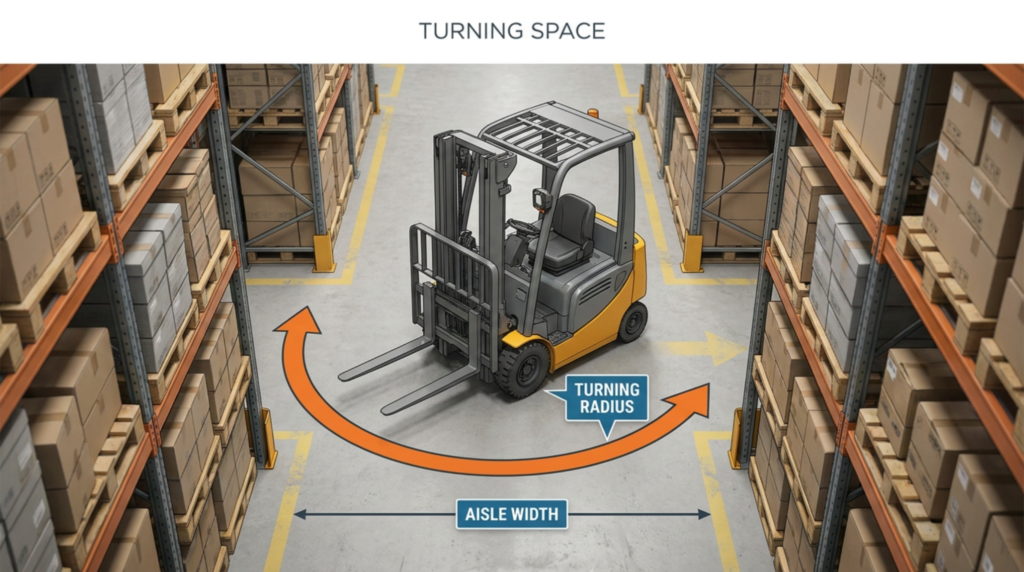
Turning space matters most in warehouses, loading areas, and narrow passages where room is at a premium. In these settings, the aisle width must accommodate not just the machine’s body but the full arc it needs to swing and align with a pallet position. A forklift that turns tightly lets you design narrower aisles and store more product in the same building, while a machine that needs a wide berth forces wider aisles and reduces usable storage. The relationship between machine dimensions and turning space therefore affects both daily efficiency and the overall capacity of your facility.
Several factors tie machine dimensions to turning performance:
- Aisle width requirements: longer machines demand wider aisles to complete turns safely.
- Repositioning speed: compact dimensions allow quicker alignment with pallets and racking.
- Storage density: tighter turning supports narrower aisles and more efficient use of floor space.
When you evaluate a forklift, look at its turning radius alongside its length, and compare both against the tightest spaces it will work in. A machine sized correctly for your aisles moves confidently and lines up loads without repeated adjustments. One that is too large for the space struggles to turn, slows operations, and increases the risk of contact with surrounding structures. Matching turning requirements to your layout keeps the work flowing and protects both product and equipment.
Transport Planning Starts With the Base Dimensions
Before a forklift ever lifts a load, it has to reach your site, move through your gates, and fit into its storage location, and all of that planning starts with the base dimensions. Knowing the machine’s length without forks makes it far easier to arrange transportation, plan storage, and confirm access through doors, gates, and other openings. The base measurement gives you a reliable figure to work with, since forks can often be removed or repositioned for transport, leaving the body of the machine as the key dimension to plan around.
Accurate dimensions help you prevent clearance problems before delivery rather than discovering them at the worst possible moment. When you know the base length, you can check whether the forklift will pass through a facility entrance, fit onto a transport trailer, and rest in its designated parking area without obstruction. This foresight avoids the costly delays and improvised solutions that arise when a machine arrives and cannot get where it needs to go.
Base dimensions support planning in several practical ways. For transport, they help you select the right trailer and secure the load correctly for the journey. For storage, they let you allocate a space that fits the machine without crowding walkways or other equipment. For access, they confirm that gates, doorways, and internal passages provide enough clearance for the machine to move in and out safely. Taking the time to verify these measurements against your routes and openings turns delivery day into a straightforward process. Skipping that step invites clearance issues that can stall a project and complicate access long after the machine is in service. Starting with the base dimensions gives you a dependable foundation for every logistical decision surrounding the forklift.
Compare Dimensions Before Choosing a Forklift
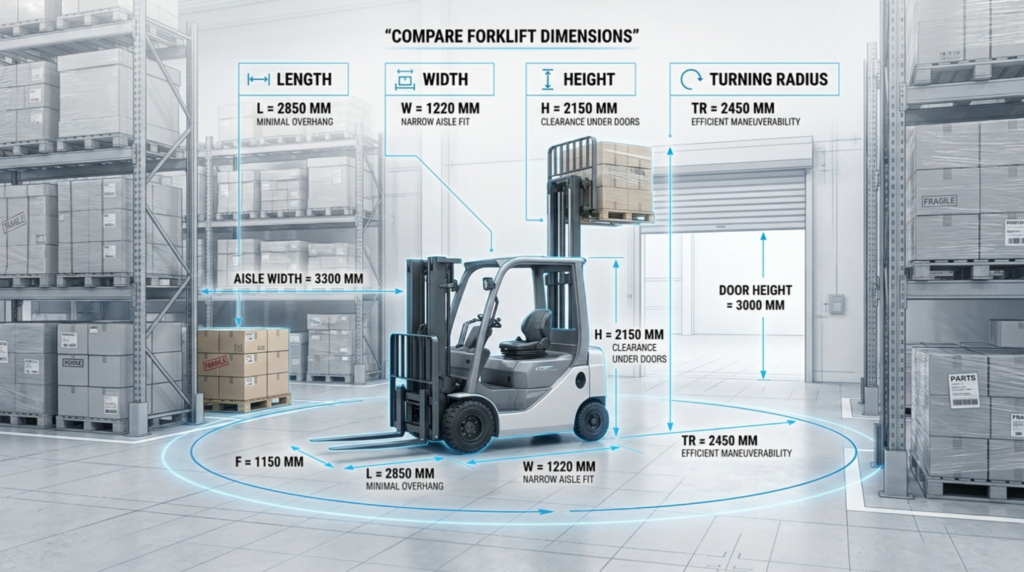
Machine length is important, but it should never be judged in isolation. A sound purchasing decision weighs length alongside width, height, turning radius, and lifting capacity, because these dimensions work together to determine how well the forklift suits your environment. A machine that looks ideal on length alone may prove too wide for your aisles, too tall for your doorways, or short on the capacity your loads demand. Comparing the full set of dimensions gives you a complete picture and helps you avoid a costly mismatch.
Each dimension answers a different question about fit. Width determines whether the machine passes through aisles and openings. Height affects clearance under doorways, racking, and building structures. Turning radius governs how the machine maneuvers and how narrow your aisles can be. Lifting capacity confirms the forklift can handle your heaviest routine loads safely. Length ties into all of these by shaping maneuverability, turning space, and transport planning. Considered together, these figures reveal whether a machine will thrive in your workspace or struggle against its constraints.
A practical approach is to measure your work environment first, then match a forklift to those requirements rather than the reverse. Note your aisle widths, door heights, turning areas, and the weights and sizes of your loads. With those numbers in hand, you can compare candidate machines against real constraints instead of relying on impressions. This method helps ensure safer, more efficient operation, because the forklift you choose is sized for the actual conditions it will face every day. Matching overall dimensions to the work environment protects your operators, your product, and your facility, and it delivers a machine that performs dependably from the first shift onward.
Conclusion
The forklift’s length without forks may seem like a minor specification, but it shapes maneuverability, turning space, and transport planning in ways that affect your operation every day. Separating the base length from the added fork length gives you a clearer view of how the machine moves at rest and in action. Length works together with width, height, turning radius, and lifting capacity, so evaluate them as a set against your actual workspace. Measure your aisles, doorways, and loads first, then match a forklift to those real conditions. Choose a machine sized for your environment, and it will operate safely and efficiently through every shift.
Frequently Asked Questions
1. What does “forklift length without forks” actually measure?
The length without forks measures the main body of the forklift, from the rear of the counterweight to the front face of the carriage, excluding the forks themselves. This base dimension tells you how much space the machine occupies before the forks add their length. It is a useful figure because forks can vary in length and are often removed or repositioned for transport, so the base measurement gives you a consistent number for comparing machines and planning how the truck fits your aisles, doorways, and storage areas.
2. Why should I separate the base length from the fork length?
Separating the two figures gives you an accurate picture of how the forklift performs both at rest and during operation. The base length helps you plan storage, transport, and access through gates and doors, while the fork length shows how far the machine reaches during active work. Standard forks often add roughly 42 to 48 inches to the front. Knowing both numbers lets you compare machines fairly, calculate the true operating length for your setup, and avoid clearance surprises when the forklift arrives and has to work in your real layout.
3. How does machine length affect turning space in a warehouse?
A longer forklift sweeps a wider arc when it turns, so it needs more open floor to reposition without striking racking, walls, or nearby loads. This directly influences how narrow your aisles can be. A machine that turns tightly supports narrower aisles and higher storage density, while one that needs a wide berth forces wider aisles and reduces usable space. When evaluating a forklift, compare its turning radius and length against the tightest areas it will work in, so it can align with pallets confidently and without repeated adjustments.
4. Why do base dimensions matter for transport and delivery?
Base dimensions determine whether the forklift can reach your site, pass through gates and doorways, fit onto a transport trailer, and rest in its storage location. Knowing the length without forks lets you select the right trailer, secure the machine properly, and confirm clearance through openings before delivery. This planning prevents costly delays and improvised fixes that occur when a machine arrives and cannot get where it needs to go. Verifying these measurements against your routes and access points turns delivery into a smooth, predictable process.
5. What dimensions should I compare before choosing a forklift?
Length should be weighed alongside width, height, turning radius, and lifting capacity, since these dimensions work together to determine fit. Width confirms the machine passes through aisles and openings, height affects clearance under doorways and racking, turning radius governs maneuverability, and lifting capacity ensures the forklift handles your heaviest routine loads. Measure your work environment first, noting aisle widths, door heights, turning areas, and load sizes, then match a forklift to those requirements. This approach helps ensure safer, more efficient operation because the machine is sized for the conditions it will face daily.